21700 or 18650 battery: which one for your box mod
Two numbers appear on the spec sheet of every mod with a removable cell, and they cause a surprising amount of hesitation at the counter. Should you stay with the proven 18650, or move to a 21700 and its reputation for stamina? Choosing between a 21700 or 18650 battery is not a matter of taste. Behind those digits sit exact dimensions, different capacities and safety questions nobody should wave away. Getting it wrong means a cell that will not physically fit, or a device that runs flat halfway through the afternoon.
21700 or 18650 battery: what your box mod will actually take
The choice between a 21700 or 18650 battery is settled first by the device itself. A mod imposes a format, and no amount of goodwill will push a thicker cell into a bay drawn for a slimmer one. Where a mod accepts both, the decision opens up.
When both fit, the 21700 brings more capacity and therefore more time between charges, while the 18650 keeps the advantage of a slimmer body and a far wider catalogue of references on British shelves. The first favours endurance, the second favours weight and pocket comfort.
There is no superior cell in the abstract. There is the format your device demands, and the trade you are willing to make between runtime and bulk.
A question of millimetres before anything else
These names are not obscure trade codes. They describe the object, and that is where any honest comparison starts.
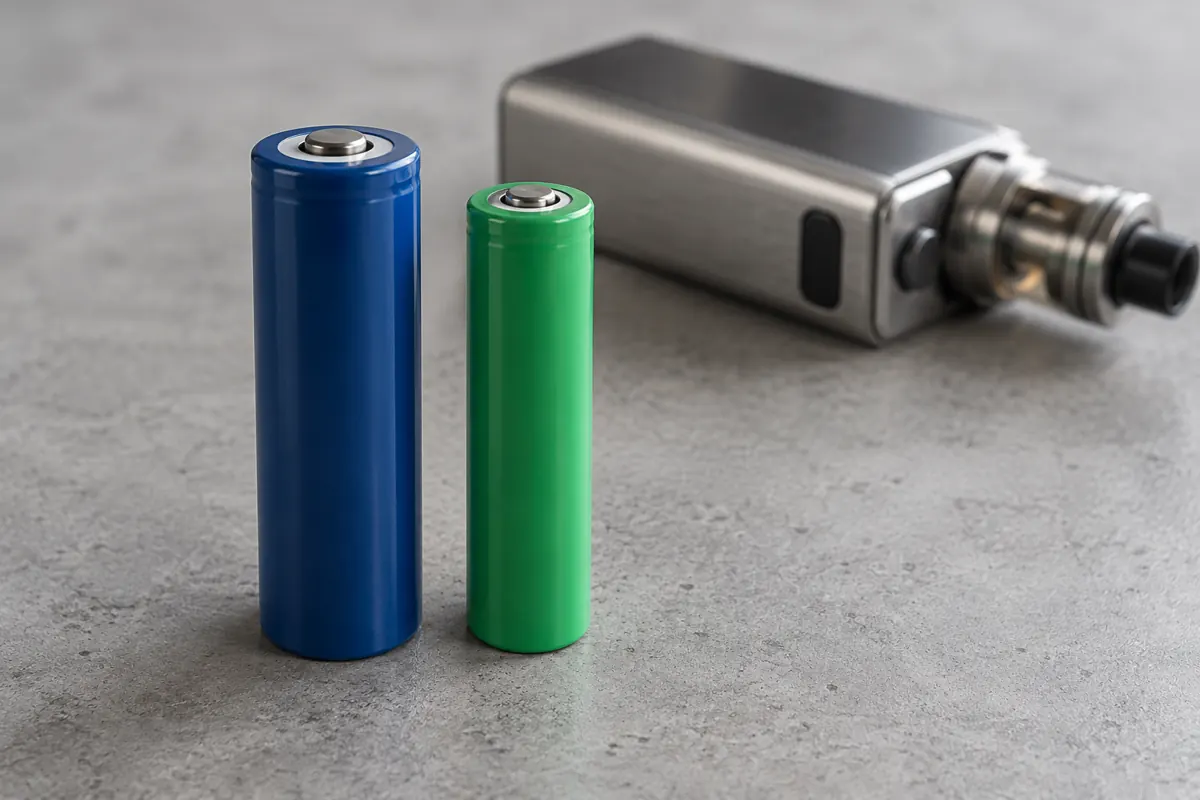
An 18650 measures 18 mm across and 65 mm long. A 21700 measures 21 mm across and 70 mm long. Three millimetres of diameter and five of length read as nothing on paper, yet they translate into a noticeably larger internal volume, and therefore into a higher potential capacity.
That same geometry explains the incompatibility. A 21700 will not drop into a bay machined for an 18650, and no adapter exists in that direction. The constraint is physical long before it is a matter of preference.
Capacity, and what it changes across a day
The extra volume of the larger format does not stay theoretical. It shows up in how often you reach for a charger, which is the main argument in favour of the 21700.
Thanks to its size, a 21700 carries a capacity commonly quoted up to around 5000 mAh, where an 18650 generally tops out near 3500 mAh. That reserve stretches the gap between charges, which matters to anyone running higher wattages and emptying cells quickly.
The 18650 keeps its own case. A single cell 18650 device stays lighter and slimmer, which counts for a lot when the mod lives in a coat pocket all day. Plenty of British vapers deliberately give up runtime to carry something they barely notice.
Discharge current: read the datasheet, do not copy a number
This is where a great many articles go wrong, by publishing a figure presented as safe. We will not, because no generic number applies to your cell, your coil and your style of vaping. What does transfer between readers is the method for reading a datasheet.
A serious cell datasheet carries three things worth cross checking. Capacity, in milliamp hours, tells you about runtime. The maximum continuous discharge rating, in amps, tells you what the cell can deliver without leaving its intended operating window. The chemistry and the actual manufacturer complete the picture.
The reasoning then runs one way only. Work out what current your setup asks for, compare it with what the cell states it can supply continuously, and keep a comfortable margin under that ceiling rather than flirting with it. A cell pushed near its limit heats up, ages fast and loses capacity.
Be wary of discharge figures printed by resellers and rewrappers, which are often lifted from packaging rather than measured. The useful reference is the datasheet published by the company that actually makes the cell. When a figure cannot be confirmed, the sensible response is not to run that setup at all.
The safety rules that never bend
Four principles apply to every device with a removable cell, whatever it cost and however long you have been vaping. They are not advanced practice, they are the entry ticket.
On a dual cell device, the cells must be matched: same model, ideally the same batch, same state of charge and the same usage history. Mixing references or ages creates an imbalance that wears both cells and leaves one working harder than the other.
The wrap, the plastic sleeve around the cell, must be intact. The smallest nick exposes the metal body and turns an accidental contact into a short circuit. A damaged wrap is replaced before any further use, or the cell leaves service.
A cell never travels loose in a pocket or a bag. It goes in a rigid case made for the job, away from keys, coins and any other metal. Charging happens on a charger suited to the format and chemistry, while somebody is around, and never on a device left unattended overnight.
Storage matters too, and it is the part most people skip. Cells kept for weeks do better at a partial charge than either full or flat, in a dry place at room temperature and away from anything metal that could bridge the terminals.
Compatibility and everyday handling
Format alone does not settle everything. Pairing it with the right device, and handling it properly, is the other half of the story.
Some modern devices take an 18650 or a 21700 interchangeably, often through an adapter supplied in the box. Others are fixed to a single format, and there the maker’s instruction is the only thing that counts. The adapter always works in the same direction, letting a smaller cell sit in a larger bay.
Choosing a format is part of a wider decision about the device itself, which our guide to picking a box mod sets out in full. If your mod has started refusing to fire, that is a separate problem covered in our piece on the No Atomizer message.
Frequently asked questions
Is a 21700 always better than an 18650?
Not at all. The 21700 holds more capacity but takes more room and will not fit every device. The 18650 stays relevant for compact hardware and moderate use. The better cell is the one that matches your bay and your wattage.
Can a 21700 go in a mod designed for an 18650?
No, the dimensions forbid it. A 21700 is both thicker and longer. Some mods do supply an adapter that lets an 18650 sit in a 21700 bay, but never the reverse.
What does the CDR figure on a cell mean?
CDR stands for continuous discharge rating, expressed in amps. It states what the cell can supply continuously within its intended operating window. It is a safety figure that deserves as much attention as the advertised capacity.
Do both cells in a dual battery device need to match?
Yes, without exception. Same brand, same model, same charge level and the same wear. Mismatched cells create an imbalance that shortens their life and raises the risk during use.
Does a higher capacity cell take longer to charge?
At equal charging power, a larger capacity logically needs a little longer for a full cycle. The gap stays modest and depends mostly on the charger. A good charger keeps the wait sensible while protecting the life of the cell.
Choosing your 21700 or 18650 battery with your eyes open
Weighing a 21700 or 18650 battery comes down to runtime against bulk, once the format imposed by your device has filtered the field. The larger cell reassures the heavy user with its reserve, the smaller one wins on slimness and sheer availability across British retailers.
In both cases, the discharge rating and the state of the wrap matter every bit as much as the capacity printed on the side. Read the maker’s datasheet, keep a margin, carry cells in a case and charge them on the right charger. That discipline around a 21700 or 18650 battery is what separates a controlled setup from a gamble, and it costs nothing but attention. More of our coverage sits in the column.
Editorial content for adult readers only. Vaping products usually contain nicotine, a substance that causes addiction. Not for sale to under-18s in the United Kingdom. This article is not a buying recommendation.